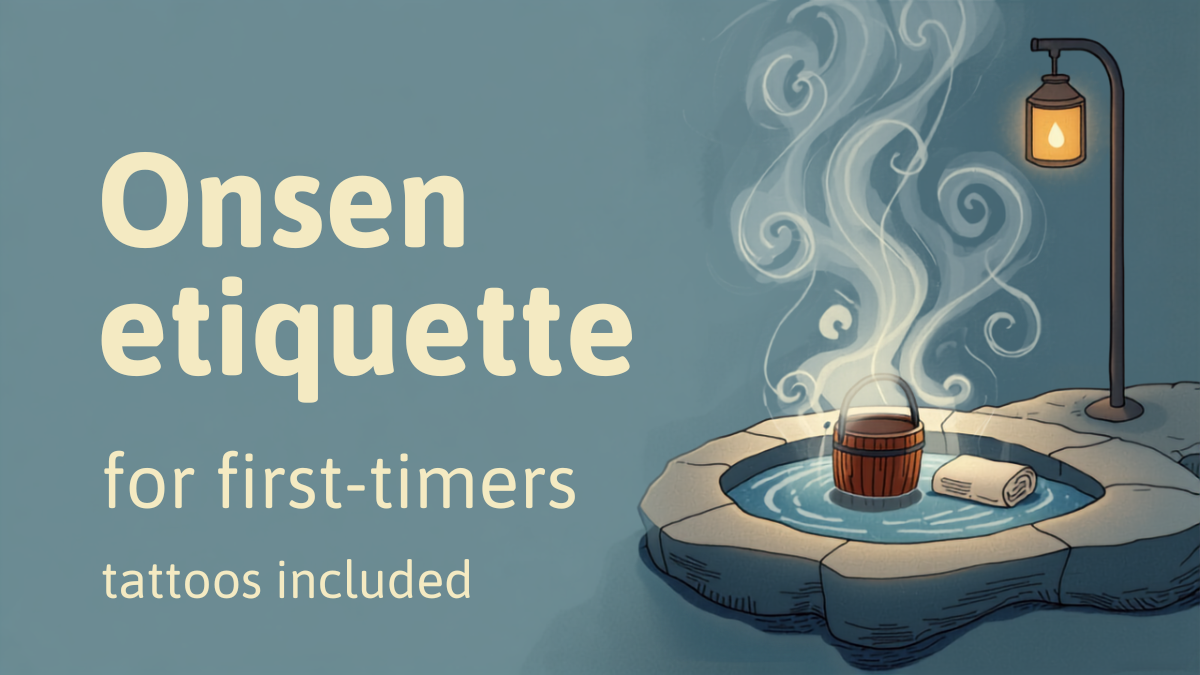
Onsen etiquette for first-timers: how to relax in a Japanese hot spring (tattoos included)
By Trip Japan YLP Editorial TeamPublished by Trip Japan YLP
In this article
Here's the thing nobody warns you about your first Japanese onsen: the hardest part is the thirty seconds before you go in. You're standing by a curtain, towel in hand, wondering if you're about to break some unspoken rule in front of a room full of strangers. Everyone I've sent to a hot spring has felt that flicker of nerves. And every one of them has come out grinning.
So let me take the mystery out of it. Onsen etiquette looks like a long list, but really it comes down to one rule and a handful of small courtesies. Get the rule right and you'll fit in just fine.
First, what counts as an onsen
An onsen is a bath fed by a natural hot spring. By Japanese law the water has to surface at 25°C or warmer, or carry a set amount of natural minerals — that's what makes it an onsen and not a sento (a neighbourhood public bath heated from the tap). The minerals are the whole point: skin-soft alkaline water in one town, iron-red water in the next.
At the entrance you'll usually meet two curtains, or noren. Navy with the character 男 is the men's side; red with 女 is the women's. Walk through, leave your clothes and your shoes in the changing room, and take only a small towel with you.
The one rule: wash before you soak
This is the big one, and it's non-negotiable. Before you get anywhere near the shared bath, you sit at one of the washing stations, and you scrub. Head to toe, properly, then rinse every last suds off. The bath itself is only for soaking — never for cleaning. Do this part well and you've basically mastered onsen etiquette.
A few more small things, and you're golden. You bathe fully nude — no swimsuits, no underwear, that's simply how it works. Your little towel is for modesty on the walk in; once you're at the water, rest it on your head or the edge of the bath, never let it dip in. Tie long hair up off your shoulders. Keep your voice low, and leave the phone in the locker — bathing areas are camera-free, always.
If you have tattoos, read this
Here's the honest part. Plenty of onsen still turn away guests with tattoos — a hangover from the days when ink meant organised crime. But it's loosening. A 2023 industry survey found about half of hot-spring facilities had softened their stance in some way, and the Japan Tourism Agency has been nudging the industry to welcome tattooed visitors, offer cover stickers, or open up private baths.
In practice you have good options. Cover a small tattoo with a waterproof patch. Seek out a tattoo-friendly onsen. Or — my favourite fix — book a kashikiri, a private family bath you reserve just for yourself or your group, usually a 40-to-60-minute slot, anywhere from free with your room to around 3,000 yen. Behind that door, nobody's checking anything. You just soak.
Where we'd send you
If you're near us in central Japan, the obvious pilgrimage is Gero Onsen in the Gifu mountains — one of Japan's three famous springs, alongside Kusatsu and Arima, a ranking the Edo scholar Hayashi Razan set down back in 1621. It's about 90 minutes from Nagoya on the JR Hida limited express (roughly 4,500 yen), and the water is famously soft on the skin. The same Hida line rolls on to the old streets of Takayama, if you want to make a trip of it. Closer to Nagoya, Katahara Onsen is a gentle first taste.
One kind word before you go in: drink some water first, ease in slowly, and skip the bath right after a big drink or a beer. If you start to feel too warm, just step out and cool down — the locals do exactly the same.
That's really all of it. The moment you lower into the water and your shoulders finally drop — especially in an outdoor rotenburo with a mountain breeze on your face — you'll wonder what you were ever nervous about. See you in the steam.
Planning a trip around central Japan? See the small-group days we run from Nagoya.
Browse all toursDid you enjoy this story?